
“Urgency, passion, and meticulous movement”: An Interview with straw appliqué artist Jordan Ortega Aguilar
Jordan Ortega Aguilar is a straw appliqué artist living in Albuquerque. His work was recently acquired by the Nuevo Mexicano Heritage Arts Museum during the 2026 Traditional Spanish Market. NMHA reached out to him to learn more about his training, his sources of inspiration, and his plans for the future. This exchange has been slightly edited.
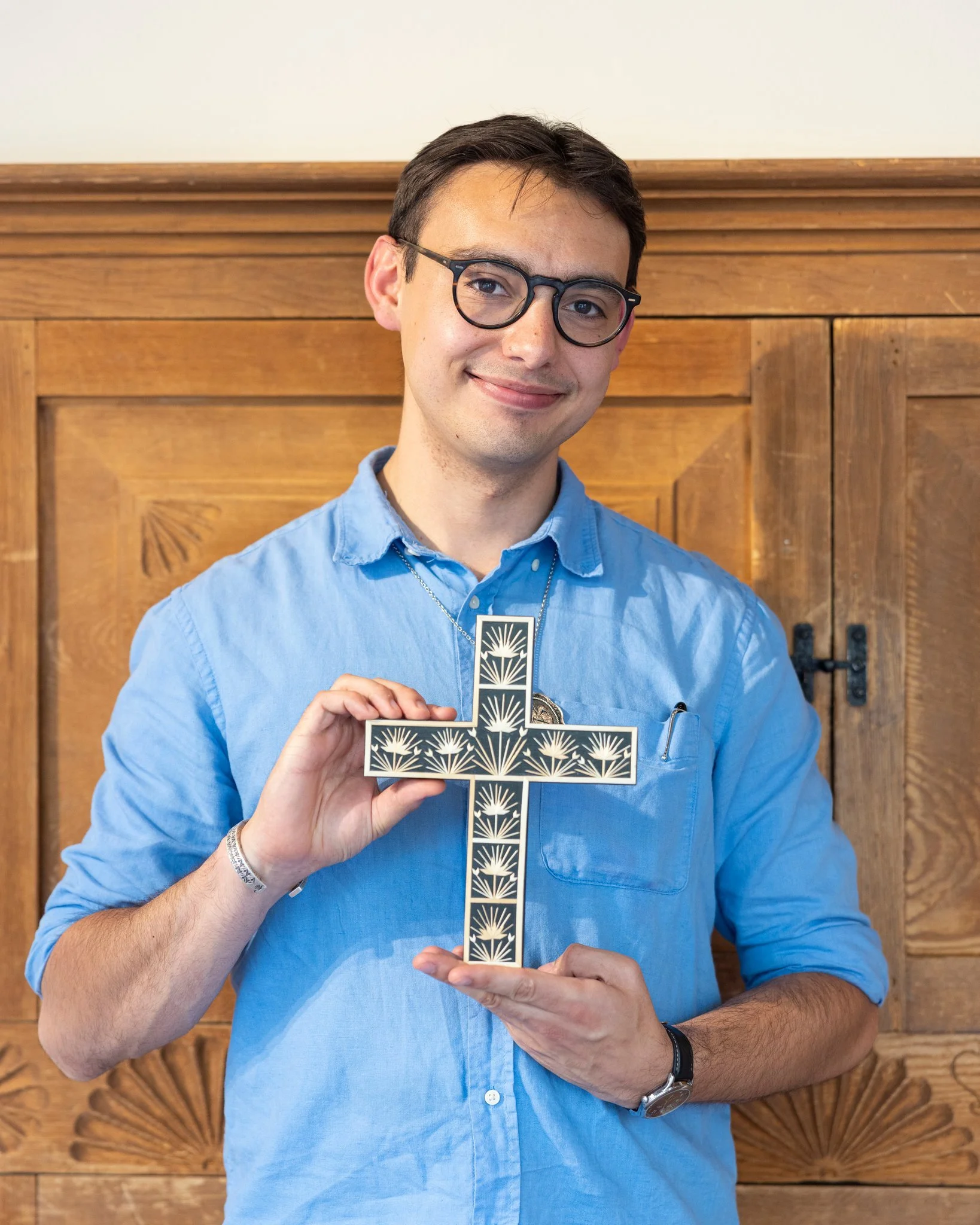
Artist Jordan Ortega Aguilar holds his straw appliqué cross that was recently acquired by the Nuevo Mexicano Heritage Arts Museum.
When did you start making art? When did you start with straw art appliqué?
In 2024 my mother and sister took a straw appliqué workshop led by Gabriela Silva at the Los Luceros Historic Site. When I returned to Santa Fe prior to the beginning of my final year at the University of Chicago, they taught me the basic techniques and motifs of the art form. Using what they had taught me, I created my first piece, which featured three cíbolo and a traditional floral motif, foreshadowing the figurative work I now create. From there, I returned to Chicago, bringing the essential materials and tools to begin what continues to be a challenging and fulfilling journey of self-guided education.
You study Spanish Language and Literature at UNM–what pathways has this course of studies opened for you?
In spring 2025, I completed my undergraduate degrees in Religious Studies and Romance Languages with honors at the University of Chicago. After taking a year off from my academic endeavors to develop my artistry, I am now a full-time master’s student in the department of Spanish & Portuguese at the University of New Mexico. In addition to being a student, I am also a teaching assistant in the Spanish as a Heritage Language (SHL) program. My academic career and artistic production are inextricably linked. To create and continue the art of our ancestors, we cannot do so in isolation; the potency of its meaning becomes diminished once the beliefs, traditions, and language through which it emerged and developed are lost. Through my studies, my academic, linguistic, and artistic interests are combined, giving me the possibility to honor our people with an impassioned and informed delicacy. I am grateful to UNM for granting me the opportunity to discuss the history, process, and meaning of my art form in the Spanish of Northern New Mexico.
I understand that you are a collector of books–what books are you drawn to, and do you also collect art?
I am drawn to Spanish language literature produced by Nuevo Mexicanos. Given my studies, I am currently interested in acquiring texts during New Mexico’s territorial period (1848-1912). In 2025, my collection received the T. Kimball Brooker Prize for Undergraduate Book Collecting. Although meager, I have started a collection of traditional New Mexican art with pieces from artists such as Bernadette Pino, Felix Lopez, Jerry Montoya, Isaiah Lopez, Eliana Esquibel Barela, and multiple youth market artists.
Who have been your mentors and teachers on your artistic journey?
I have been fortunate to receive mentorship, both artistic, personal, and spiritual from a variety of fellow artists. Namely, Felix Lopez, Joseph Lobato, Eliana Esquibel Barela, Yvonne Aragón, and Della Vigil Gonzales.
Has the Nuevo Mexicano Heritage Arts Museum been a resource for you? If so, how?
The museum has been an important resource for my understanding of the history of scholarship and conservation of Spanish colonial art in New Mexico. For multiple occasions, museum director Jana Gottshalk has granted me and my colleagues access to the museum archive. Through visiting the archive, exhibits, and attending museum events, I have deepened my understanding of both contemporary and colonial New Mexican art. In particular, their collection of pieces by Eliseo and Paula Rodriguez has significantly impacted the direction of my art.
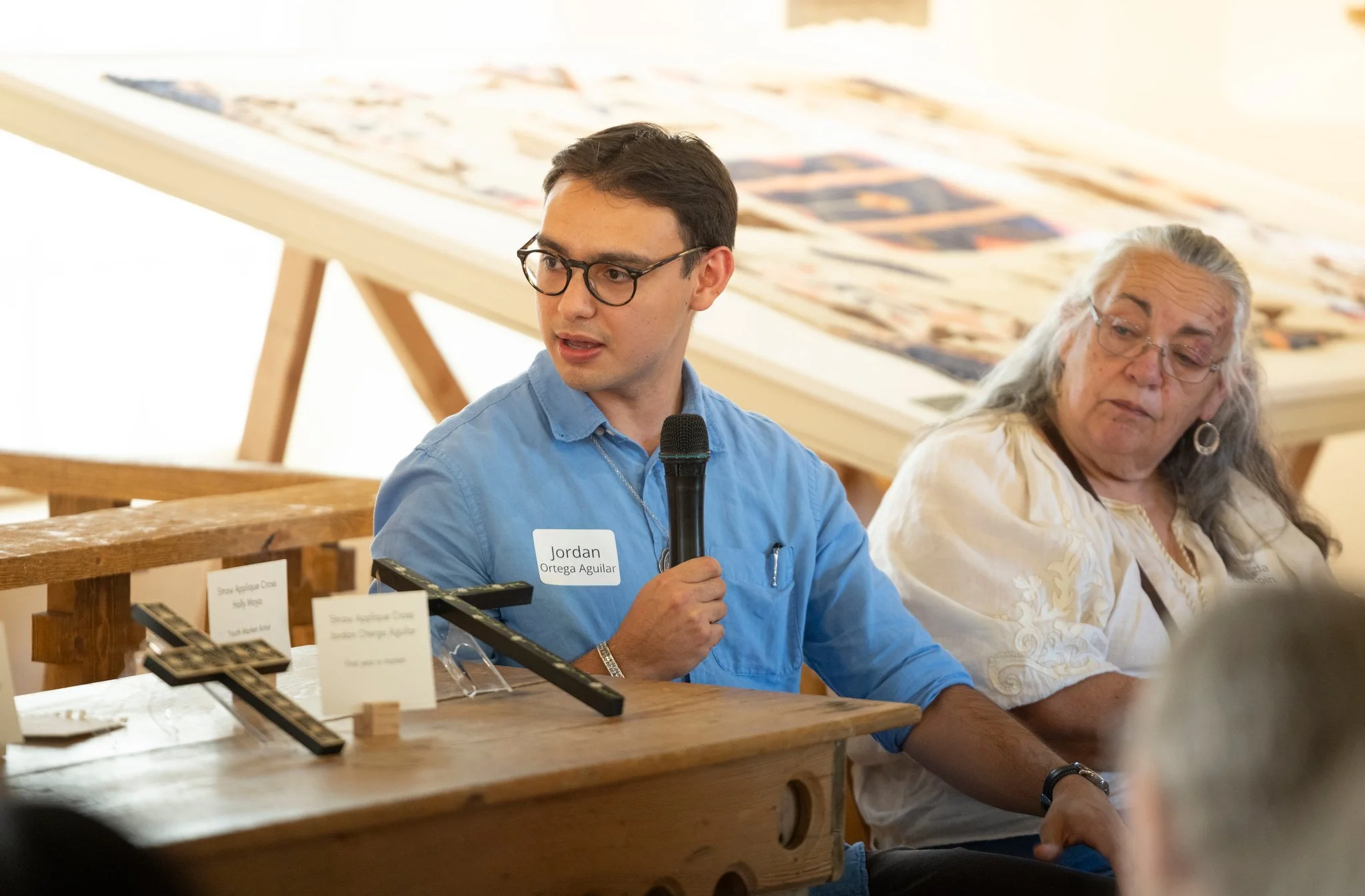
Jordan Ortega Aguilar answers questions about his work during a presentation of newly acquired art at the Nuevo Mexicano Heritage Arts Museum.
I have heard you describe your artwork as prayer. Could you talk about the sources of inspiration for your work?
As a result of my instruction in religious studies as well as my own faith, each piece is a response to an urgency to contemplate a particular life circumstance and to imitate the exemplary lives of the saints. I have been greatly inspired by Felix Lopez and his teachings on how our art is inseparable from our religion. My art becomes the object toward which my devotion is directed. When a piece leaves my hands, I want its devotional or liturgical purpose to continue, not for it to be reduced to mere decoration. I seek to accomplish this task by maintaining the traditional visual language of New Mexico and that of the schools which emerged from indigenous and Spanish colonial art abroad.
How do you approach a new piece–from inspiration to completion?
From living in Spain, Morocco, Chicago, and New Mexico, I have, throughout my life, been exposed to profoundly distinct yet related artistic cultures. Straw appliqué emerged from the Moorish art of taracea and was adopted and transmitted by the Spanish in New Mexico. Thus, I have had extensive exposure to art and art history, researching the artistic artifacts of New Mexico while living in the cultures from which they originated. Each piece is made with urgency, passion, and meticulous movement. I do not sketch the designs before, but allow the pieces, whether geometric, floral, or figurative, to emerge naturally.
This year was your first year exhibiting in the Traditional Spanish Market, and your piece, Cruz de la Caída del Hombre, won Best in Straw Appliqué. Can you tell us a little about that piece and what it felt like to have your work recognized in this way?
Cruz de la Caída del Hombre features eight congruent segments which narrate the story of the Garden of Eden found in Genesis 2:8-3:24. The account is narrated from the bottom up, then toward the left branch, the top, the right branch, and finally, the center. The scenes are as follows: La Creación, Hombre y Mujer, La Tentación, La Participación, La Huida, La Culpa, El Exilio, and La Luz. Each panel carefully reflects my interpretation and understanding of the Garden narrative. A motif which can be found throughout the entire piece is the light of God, fully realized in the central panel. That is, no matter how far man may fall, God is omnipresent and luminous. It was and is an immense honor that the culmination of a year’s worth of contemplation and study was recognized by the Traditional Spanish Market, by my community, and by my much esteemed peers.
As you look to the future, what are your hopes and plans for your own artistic practice, and for the field of traditional heritage arts more broadly?
In December, I will be participating in the 2026 Winter Spanish Market. Then, February 6th, 2027 ,will mark the opening of my solo show at the Los Lunas Museum of Heritage & Art as a result of my piece “El Descanso de San Pascual” winning best in show in 2026 at the “Vida, Cultura, y Familia” show. One day, I hope to have apprentices and to contribute to the scholarship on straw art in New Mexico. I am committed to developing both my work in straw appliqué and encrusted straw and expanding our humble world of gold.