
MANO PODEROSA (2026)
Oil and gold leaf on tondo panel 12 inches in diameter
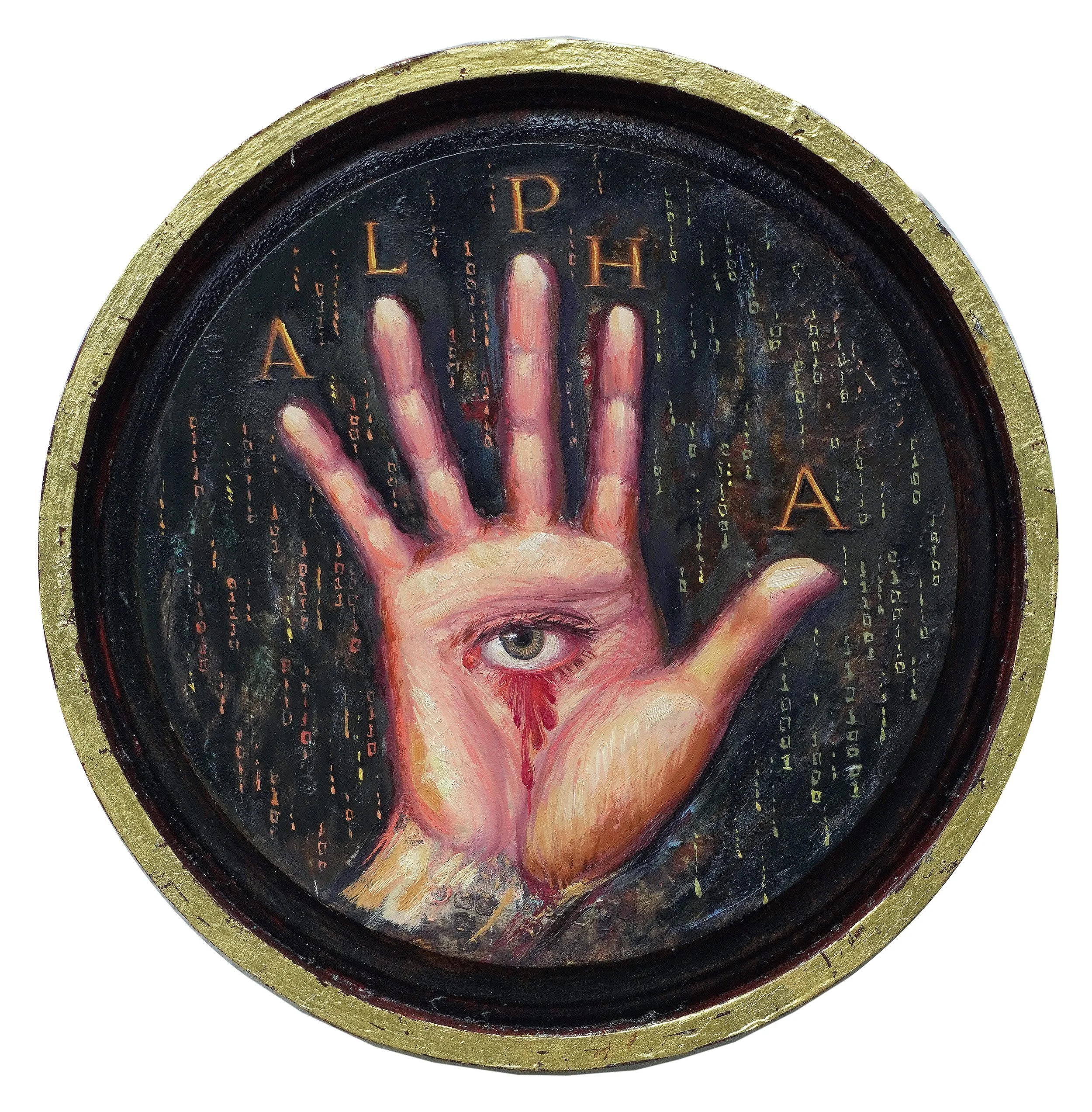
La Mano Poderosa, the All-Powerful Hand, is an image I grew up seeing: the pierced hand of Christ raised with a saint standing on each fingertip, Jesus, Mary, Joseph, and Mary's parents, Anne and Joachim, a whole holy family held in one palm. In the traditional version the wound in the palm is the mark of the crucifixion. Here the wound has opened into an eye, and it still bleeds. The eye in the palm is older than the Church. It is the hamsa, hung for centuries across the Mediterranean and the Middle East to ward off the evil eye.
Where the saints once stood, five golden letters rest over the five fingers and spell ALPHA. It is the first letter of the Greek alphabet, the beginning, the name God gives himself in the Book of Revelation: I am the Alpha and the Omega. It is also the vocabulary of dominance, and the naming convention of the companies building the first of everything. Google's parent company calls itself Alphabet, and its artificial intelligence laboratory names its breakthroughs Alpha. Binary falls through the dark behind the hand, the newest alphabet of all, reduced to two letters.
The raised open palm is both a greeting and a halting gesture, and it has not changed in tens of thousands of years. Hands stenciled on cave walls are among the oldest images we have, made long before anyone wrote a word. Leonard Shlain argued in The Alphabet Versus the Goddess that the alphabet trained our minds toward the abstract and the linear at the expense of the image. David Abram, in The Spell of the Sensuous, describes how the animism our ancestors gave to rivers, stones, and animals passed into the written letter, until the text itself began to speak to us. From letters came stories, laws, politics, religion, consumer culture, and finally computer code. It is ultimately our own human hands that give rise to the written fictions we believe in, and to the tech-driven world that now writes back.