
VIRGEN DE LAS REDES (2026)
Oil & gold leaf on panel 11.5 x 25.5 inches
VIRGEN DE LA NUBE (2026)
Oil & gold leaf on panel 11.5 x 25.5 inches.

VIRGEN DE LA NUBE
The Virgin of the Cloud is a real Marian title, from an apparition seen in the sky over Quito in 1696 and venerated in Ecuador ever since. I kept the name and moved the cloud. She stands in the pose of the Immaculate Conception, hands joined, mantle blowing, with three winged cherub heads beneath her feet. One wears a face mask from the pandemic, one a virtual reality headset, and one a clown's painted face under a pair of mouse ears. A serpent winds below them. Together they are faces of our techno-capitalist society: fear, escape, and entertainment.
Two billboards stand behind her, reading BUY and OBEY, the same commands hidden in the billboards of John Carpenter's They Live, visible only to those wearing the right glasses. Code streams down through her mantle. Her halo reads AVE MARIA MATRIX. In Latin, matrix means womb, from mater, mother, long before it named a grid of numbers or a film about a simulated world. On her chest, where the Immaculate Heart would burn, she wears a black sun, the alchemical symbol of the hidden forces of transformation that come before illumination. She looks down at the darkness below, surrounded by smoke and fire. In 1696 the faithful of Quito looked up and saw their Virgin in a cloud. Today we look down at our screens and store our lives in a cloud of our own, our photographs, our messages, everything we have ever searched for, trusting it to keep them. Beside the Virgen de las Redes, she completes the two halves of our digital faith, the network and the cloud.
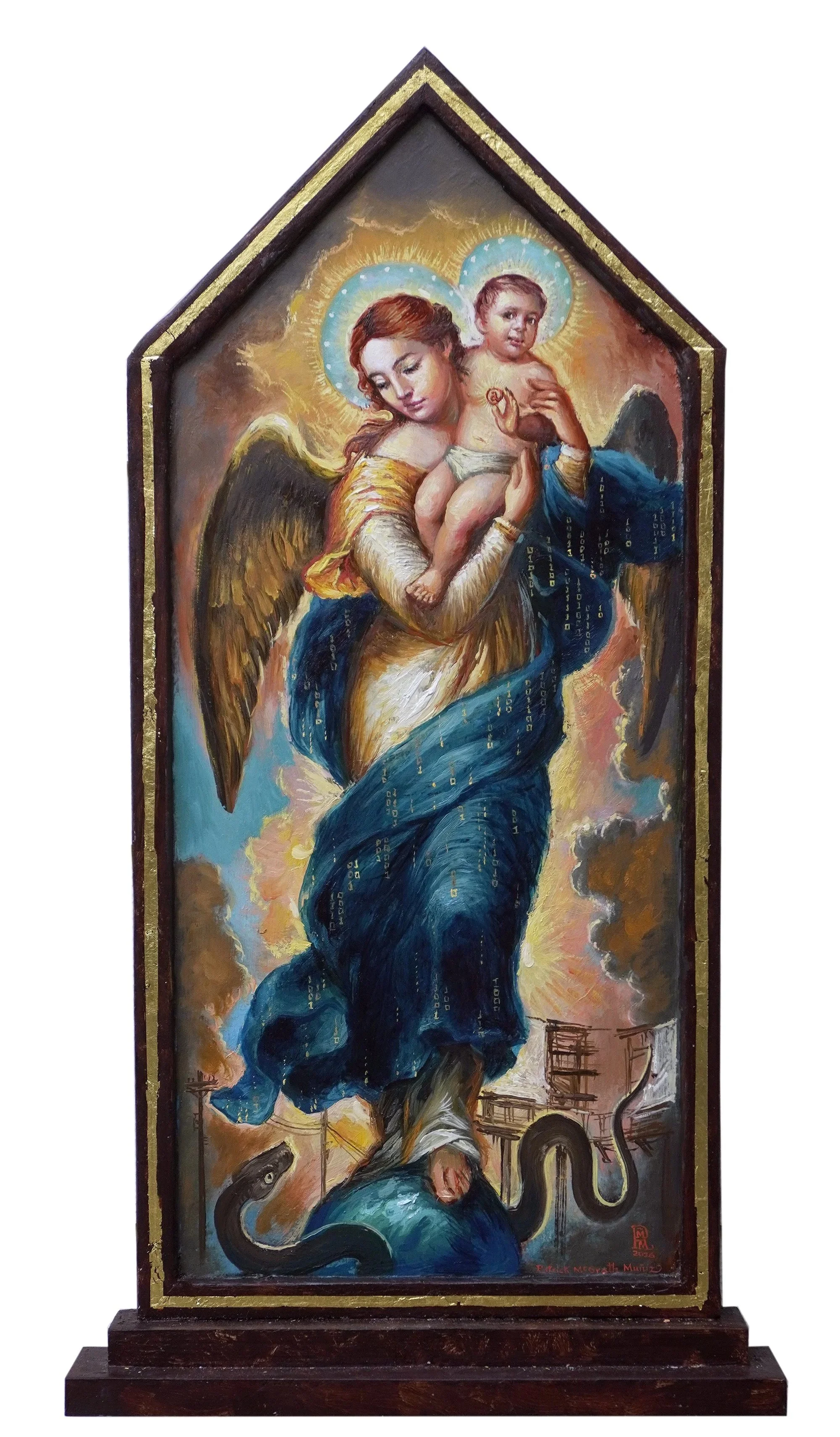
VIRGEN DE LAS REDES
Redes means networks, and it also means nets, the fishing nets of the Gospels and the networks we are caught in now. This Virgin carries her child in the manner of the colonial Madonnas, and her blue mantle is coming apart into columns of falling code. She has wings, like the Woman of the Apocalypse, who in the Book of Revelation is given the two wings of a great eagle to escape the dragon, and whom the painters of colonial Mexico loved to paint winged. Mother and child wear halos studded with small points of light, like the nodes of a network. Behind them, a broken billboard frame and electric poles strung with wires rise where a church and its spires would stand in the old paintings, the net made visible. Under her feet lie the world and the serpent, as they always do beneath the Immaculate Conception, a sign of her triumph over sin and the world.
Not much has changed, except the small thing the child holds in his fingers, the @. Merchants and scribes used it for centuries. In Spanish it is the arroba, an old unit of weight for wine and oil that crossed the Atlantic with colonial trade, and in 1971 the engineer Ray Tomlinson chose it to join a person's name to a machine in the first email address. Look closely and it is a lowercase a wrapped in a circle, a haloed letter, the new Alpha of our age, held up like a new orb, a new world to grasp and understand.
We are still humans grappling with the same devotional images, the same archetype of mother and child. We may be holding a small, curious object in our hands, and it matters that we treat it as exactly that. Our humanity should not change because of a novel technology.