
Saints and Symbols
This year our exhibit New Mexico Stories has a section about Saints and their symbols. We thought this might be a great opportunity to share this gallery guide Ren Moure created for a 2014 exhibit. Learn about symbols and their meanings through pieces in our collection! Visit New Mexico Stories, on view now, for more.
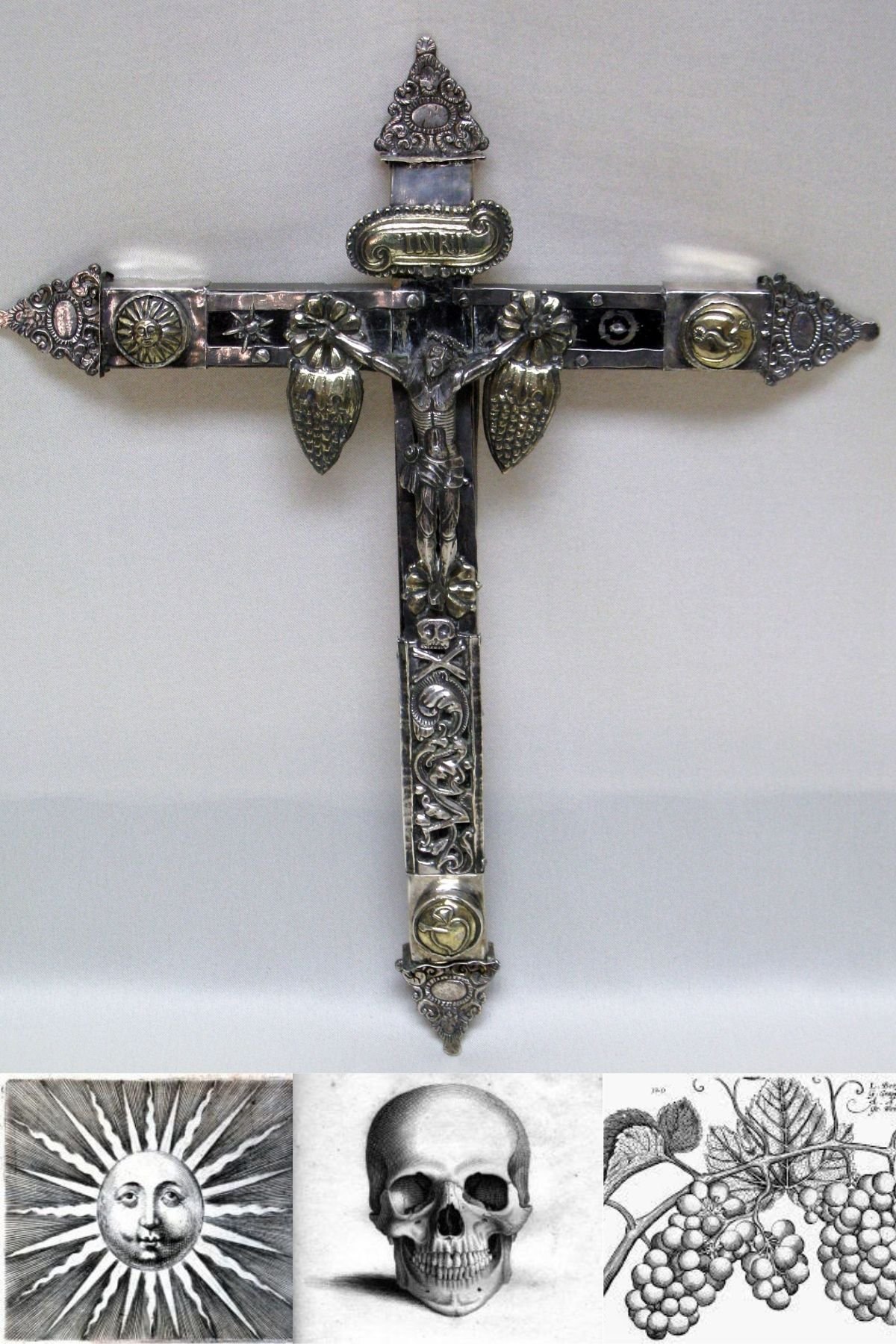
Crucifix/Crucifijo
Symbols: Sun & moon, skull & cross bones, grapes, INRI
Why those symbols? The sun and the moon symbolize the eclipse during the crucifixion. The skull and cross bones near the base of the cross refer to Golgotha, “the place of the skull,” the location where Christ was crucified. The grapes signify Christ’s blood spilled to free mankind of sin. INRI was the sign that Pilate had nailed to the cross standing for Iesus Hominem Rex Iudeorum “Jesus King of the Jews.”
Crucifix
Maker currently unknown
Peru, 19th c.
Silver, wood, brass
Gift of the Beltran-Kropp Foundation; 2012.051
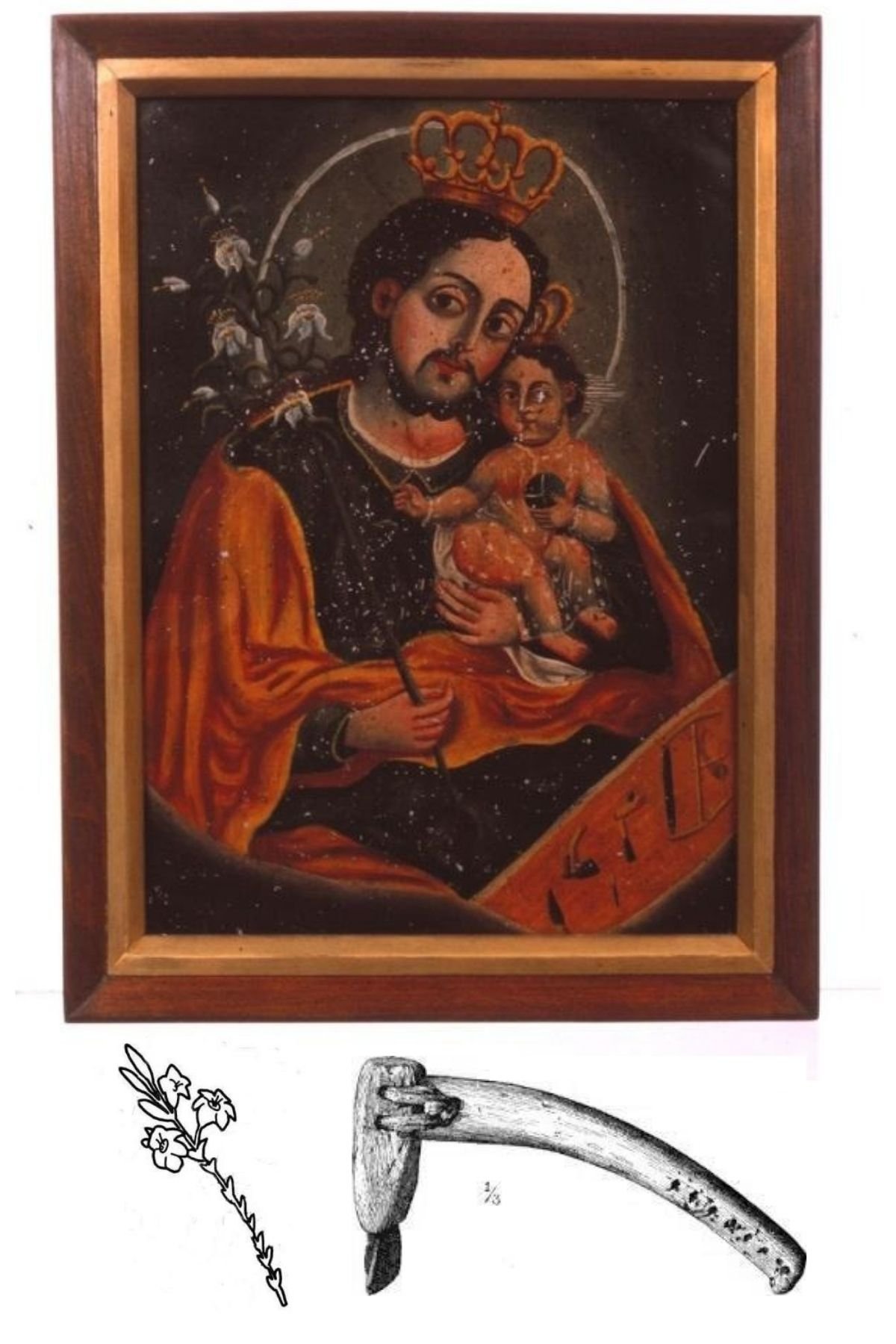
Saint Joseph / San José
Symbols: Flowering staff, baby Jesus, carpenter’s tools
Why those symbols? The flowering staff refers to the legend in which Mary’s suitors were directed to bring a staff to the temple. The staff belonging to Joseph miraculously bloomed indicating that he was divinely chosen to be Mary’s husband. The baby Jesus in his arms shows his position as the earthly caretaker of the Holy Family and the carpenter’s tools reflect his trade.
St. Joseph with the Christ Child, San José con el Niño Jesus
Maker currently unknown
Mexico, late 19th c.
Tin, oil paint
Museum purchase; 1964.027
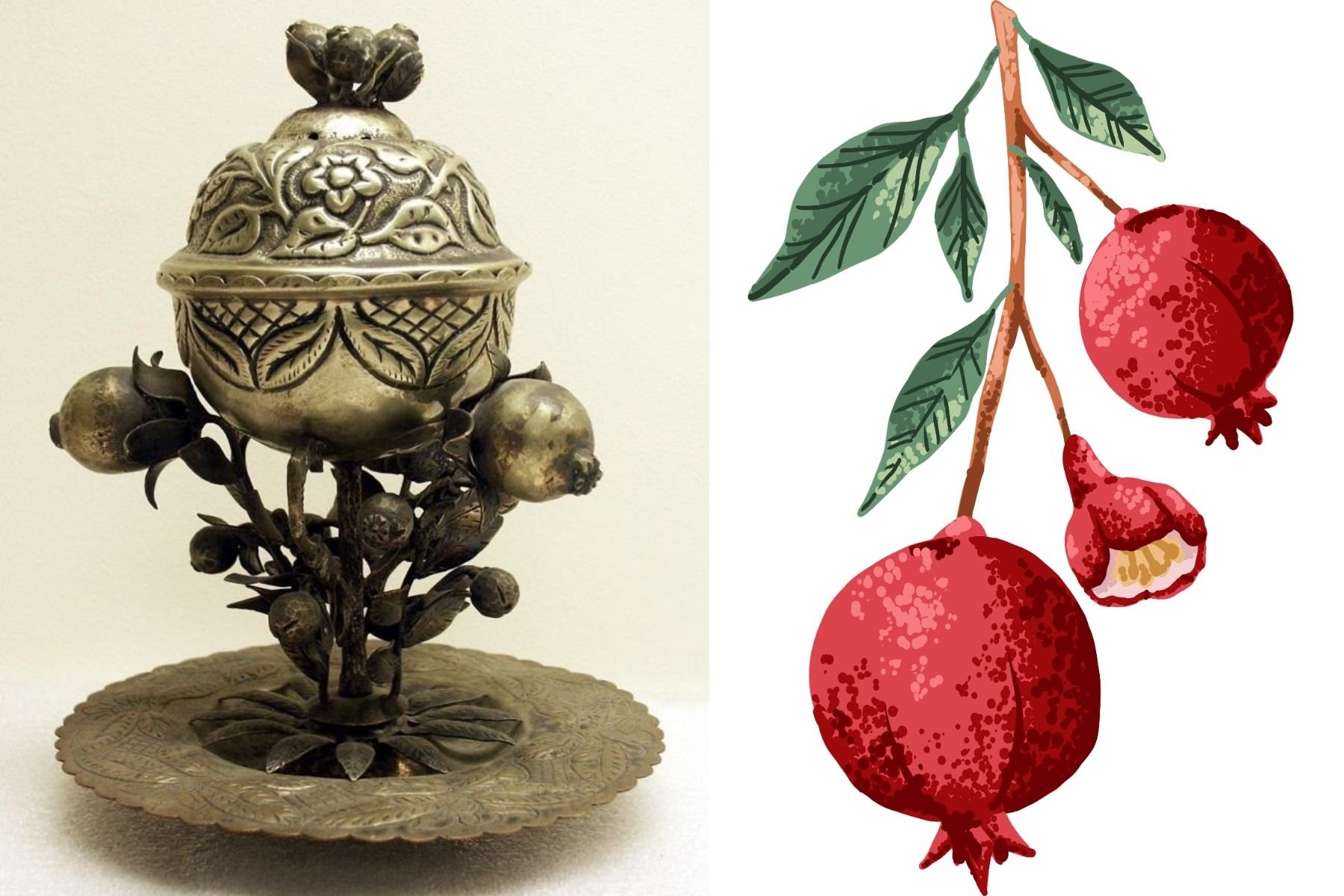
Incense Burner / Sahumador
Symbol: The Pomegranate
Why this symbol? The pomegranate primarily symbolizes the Church because the many seeds (representing the faithful) are united in one fruit (Catholicism). It was given a political meaning for the Spanish because when Queen Isabela and King Ferdinand conquered the last stronghold of Muslims in Granada, they added the pomegranate (granada) to their coat of arms symbolizing the triumph of Christianity over Islam.
Incense Burner/ Incensario
Maker currently unknown
South America, 19th c.
Silver, copper
Gift of Charmay B. Allred ; 2000.045
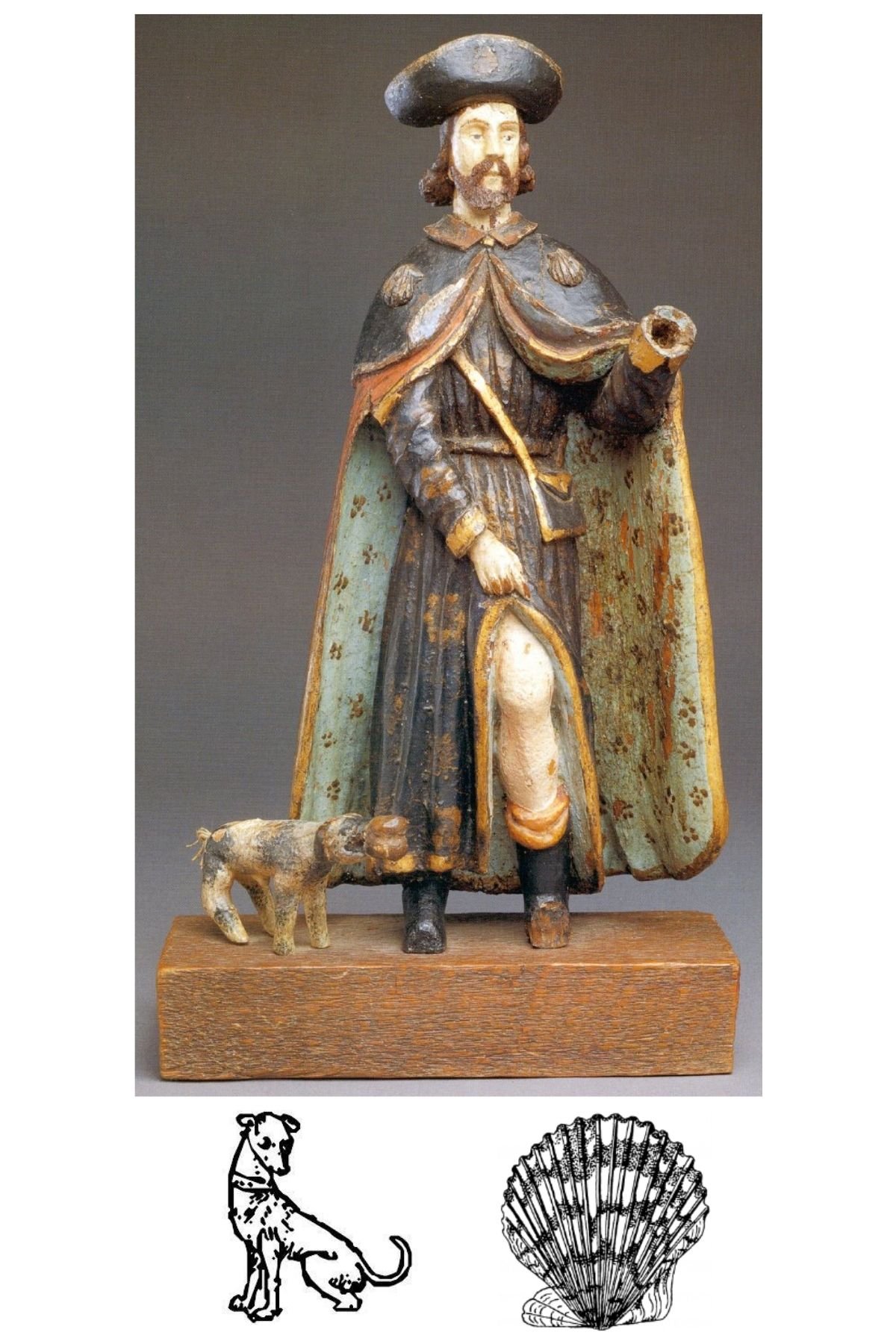
Saint Roch/San Roque
Symbols: Dog, scallop shell, staff
Why those symbols? Saint Roch was orphaned at 20 and subsequently gave his inheritance away to the poor. He embarked on a pilgrimage to Rome, thus he is garbed in the uniform of the time for pilgrims: a broad-brimmed hat, a scallop shell and a staff. On the journey he traveled from town to town healing plague victims with the sign of the cross. On his return he caught the plague, symbolized by the sore on his leg. He was brought back to health by a dog which brought him food scraps from its master’s table and an angel who nursed him.
The scallop shell (cockleshell) became a symbol of pilgrimage in the Middle Ages, especially to Santiago de Compostela, Spain. As pilgrims traveled they could ask (of even the poorest people they met) for a serving of food in the shell they carried, without being a burden.
San Roque
Maker currently unknown
Spain, 19th c.
Wood, gesso, paint
Bequest of Ann & Alan Vedder; 1990.052
Bibliography
Chorpenning, Joseph F. ed., Mexican Devotional Retablos: From the Peters Collection, Philladelphia: Saint Joseph’s University Press, 1994.
Ferguson, George, Signs and Symbols in Christian Art, New York: Oxford University Press, 1954.
Gardner’s Art Through the Ages, Sixth Edition, New York: HB&J, 1975.
Gettig, Lynda Jessen, The History of the Cross in Religious & Political Symbolism, Wickenberg, AZ: Rainbow Hogan Museum of the Cross, 1989.
Giffords, Gloria Fraser, Mexican Folk Retablos: Masterpieces on Tin, Tucson, AZ, University of Arizona Press: 1974.
Giorgi, Rosa, Saints and Their Symbols, New York: Abrams, 2011.
Husenbeth, F.C., Emblems of Saints, Norwich, UK: A. H Goose & Co., 1882.
Jöckle, Clemens, Encyclopedia of Saints, London: Alpine Fine Arts Collection, Ltd.,1995.
Kelly, Sean and Rogers, Rosemary, Saints Preserve Us!, New York: Random, 1993.
Kuhns, Elizabeth, The Habit, New York: Doubleday, 2003.
Metford, J.C.J., Dictionary of Christian Lore and Legend, London: Thames & Hudson, 1983.
Sill, Gertrude Grace, A Handbook of Symbols in Christian Art, New York: Collier Books, 1975.