
EL ANTÍDOTO (2026)
Oil on triptych panel 36.5 x 33 inches.

Artist’s description
Open and Closed
The central figure is Temperance, the virtue that mixes and moderates. In the Tarot and in the old allegories of the cardinal virtues, she pours water from one vessel into another. Here the stream falls from her open hands as two columns of green code, standing behind her like the pillars of a temple and pouring into the chalices below. One chalice is dark, with the Moon above it. The other is golden, with the Sun. They are the polar opposites found in nature, in ourselves, and in the technologies we have created, and a crescent moon beneath her feet binds them together, the same crescent the Woman of the Apocalypse stands on in colonial paintings of the Virgin. She stands on a computational cloud that is slowly dissolving into pixels. Behind her, across a sea of data, a Spanish caravel and a modern cargo ship trace five centuries of transnational global enterprise. Flanking her are two crowned columns wrapped in banners, the Pillars of Hercules and their motto PLUS ULTRA, "further beyond," the emblem of the Spanish empire, stamped on its silver coins and one of the proposed origins of the dollar sign.
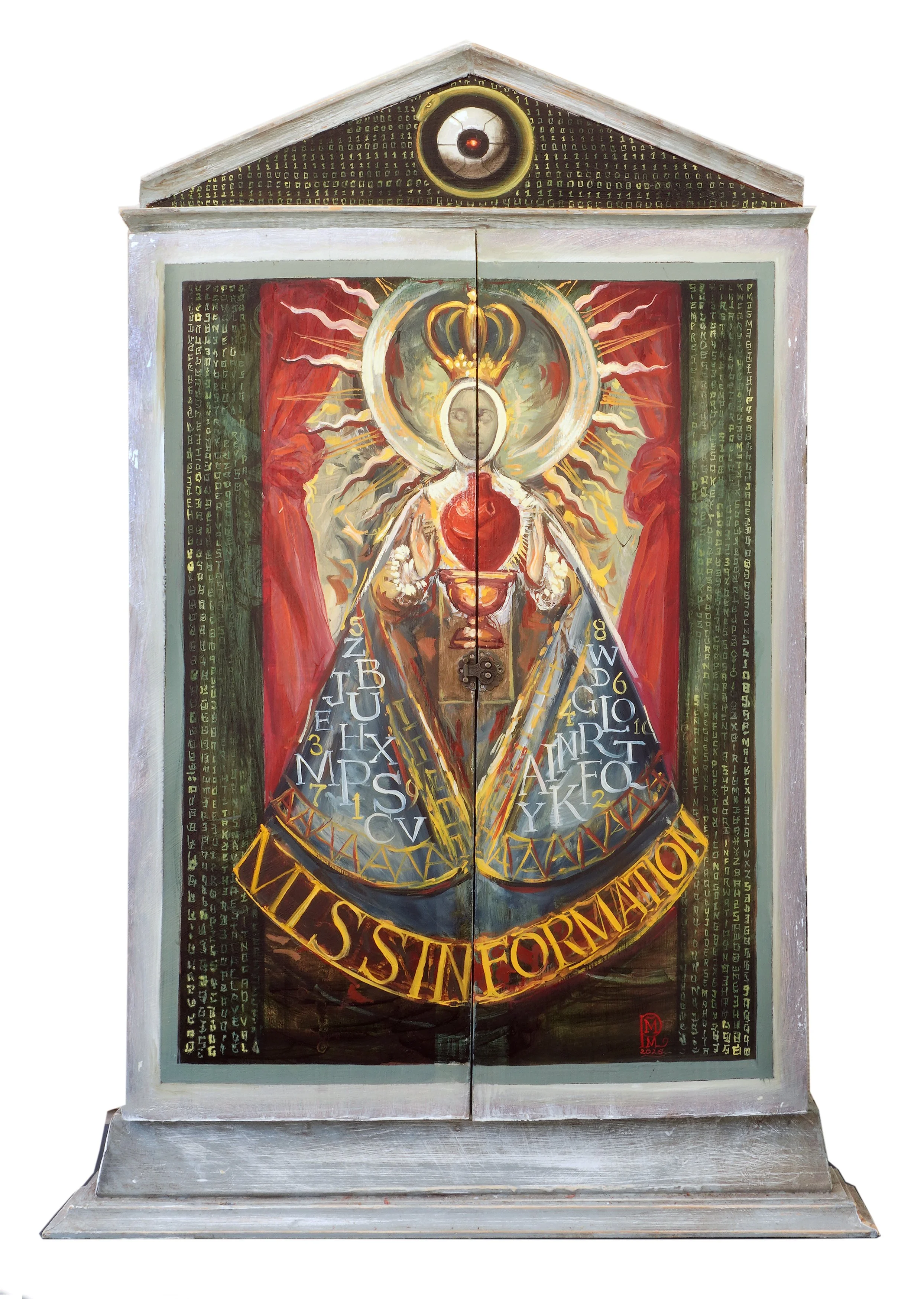
The inscription above her head reads ARS ANTIDOTUM EST. Art is the antidote. It is the phrase at the heart of this exhibition. In the pediment above, a camera eye looks back at us, encircled by an ouroboros biting its own tail against a dark field of binary, the cycle of life and death that governs any system, organic or computational.
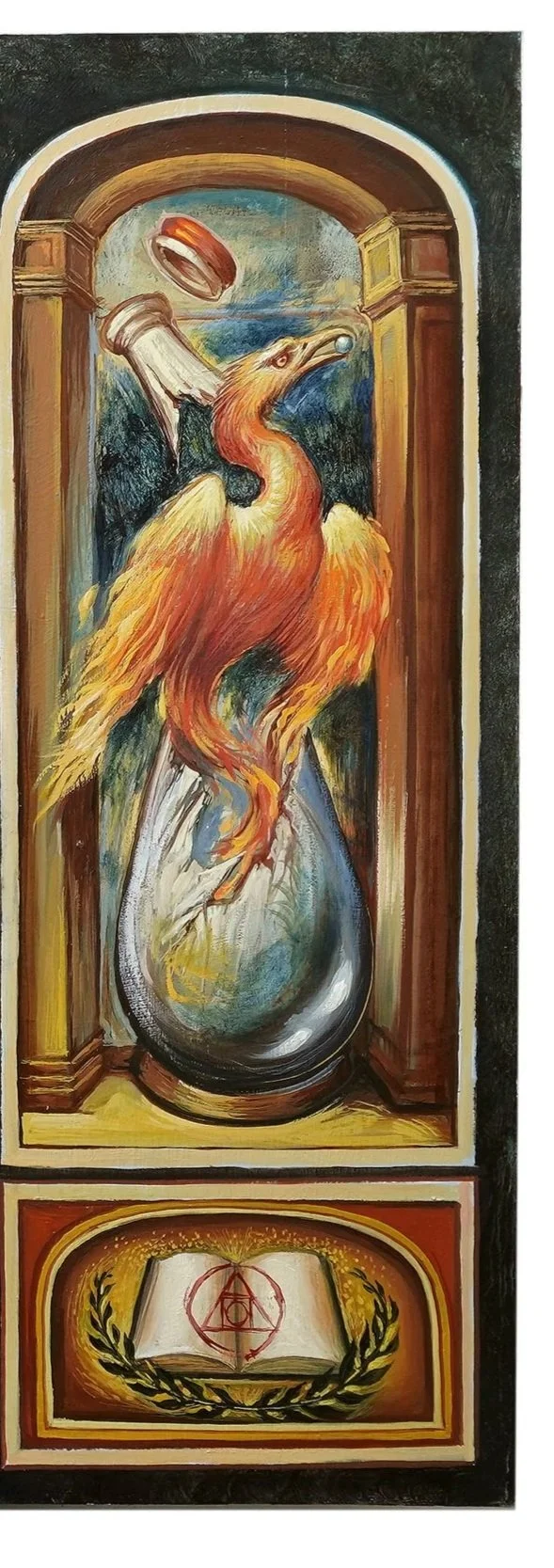
The wings hold two alchemical vessels. The first is crowned and holds three birds, black, white, and red, the three great stages of the work: the nigredo, the albedo, and the rubedo. In the second, the glass has broken and a phoenix of fire flies free, liberation and the final stage of the Magnum Opus. This is the end of the work, the thing that survives its own burning. Below them, tablets burn in a fire marked with the signs of mercury, salt, and sulfur, the three principles of Paracelsus. On the other side, a book rests inside a laurel wreath, bearing the sign of the philosopher's stone.
Closed, the doors show a Virgin in the colonial manner, robed and crowned, standing between parted red curtains like a figure on a stage, with a banner across her feet reading MISS INFORMATION. Read one way it is a title, a pageant sash, a beauty queen. Read the other way it is precisely what she is dispensing. Code rains down behind her, and the letters and numbers woven into her mantle are the fictional code on which our whole civilization is built. With her open hands she presents a heart rising from a chalice, our human essence emerging from the inventions that encapsulate it.
Descripción del artista
Abierto y cerrado
La figura central es la Templanza, la virtud que mezcla y modera. En el Tarot y en las antiguas alegorías de las virtudes cardinales, vierte agua de una vasija a otra. Aquí el chorro cae de sus manos abiertas en dos columnas de código verde que se alzan detrás de ella como los pilares de un templo y se vierten en los cálices de abajo. Un cáliz es oscuro, con la Luna encima. El otro es dorado, con el Sol. Son los opuestos polares que encontramos en la naturaleza, en nosotros mismos y en las tecnologías que hemos creado, y una media luna bajo sus pies los une, la misma luna sobre la que se para la Mujer del Apocalipsis en las pinturas coloniales de la Virgen. Bajo la media luna, una nube computacional se va disolviendo en píxeles. Detrás de ella, a través de un mar de datos, una carabela española y un buque de carga moderno trazan cinco siglos de empresa global. La flanquean dos columnas coronadas y envueltas en bandas, las Columnas de Hércules con su lema PLUS ULTRA, “más allá”, emblema del imperio español, acuñado en sus monedas de plata y uno de los orígenes propuestos del signo de dólar.
La inscripción sobre su cabeza dice ARS ANTIDOTUM EST. El arte es el antídoto. Es la frase en el corazón de esta exposición. En el frontón, un ojo de cámara nos devuelve la mirada, rodeado por un uróboros que se muerde la cola sobre un campo oscuro de código binario, el ciclo de vida y muerte que gobierna cualquier sistema, orgánico o computacional.
Las alas del tríptico guardan dos vasijas alquímicas. La primera está coronada y contiene tres pájaros, negro, blanco y rojo, las tres grandes etapas de la obra: la nigredo, la albedo y la rubedo. En la segunda, el vidrio se ha roto y un fénix de fuego escapa, la liberación y la etapa final del Magnum Opus. Ese es el final de la obra, lo que sobrevive a su propia quema. Debajo de la primera, unas tabletas arden en un fuego marcado con los signos del mercurio, la sal y el azufre, los tres principios de Paracelso. Debajo de la segunda, un libro descansa dentro de una corona de laurel, con el signo de la piedra filosofal.
Cerradas, las puertas muestran una Virgen a la manera colonial, vestida y coronada, de pie entre cortinas rojas abiertas como una figura en un escenario, con una banda a sus pies que dice MISS INFORMATION. Leída de una manera, es un título, una banda de certamen, una reina de belleza. Leída de corrido, misinformation, es exactamente lo que reparte: desinformación. El código llueve detrás de ella, y las letras y los números tejidos en su manto son el código ficticio sobre el que está construida toda nuestra civilización. Con las manos abiertas presenta un corazón que surge de un cáliz, nuestra esencia humana emergiendo de los inventos que la encierran.